
- Best Sneakers
- latest Running Sneakers
- Sportswear Design
- jordan release date
- Buy Sneakers
- nike dunk low purple pulse w dm9467 500
- nike dunk low pro sb 304292 102 white black trail end brown sneakers
- nike kyrie 7 expressions dc0589 003 release date info
- new air jordan 1 high og osb dian blue chill white cd0463 401
- sacai nike ldwaffle white wolf BV0073 100 on feet release date
- Home
- Articles Archive, 2006-2016
- Golden Oldies
- 2016-2026 Articles Archive
- A Study of Dom Prosper Gueranger's Detailed Defense of The Mystical City of God Now Published in Kindle and Paperback
- About This Site
- As Relevant Now as It Was One Hundred Six Years Ago: Our Lady's Fatima Message
- Donations (October 7, 2025)
- Now Available for Purchase: Paperback Edition of G.I.R.M. Warfare: The Conciliar Church's Unremitting Warfare Against Catholic Faith and Worship
- Ordering Dr. Droleskey's Books
- US Coalition for Life Appeal to Help the Catholics of the Holy Land
On the Comemorated Feast of Saint Aloysius Gonazaga, S.J., June 21, 2026
Saint Aloysius Gonzaga is one of Holy Mother Church's shining examples of a youth who maintained his innocence and purity throughout his twenty-three years of life as a member of the Church Militant on earth. I have had a particular devotion to this great lover of Our Blessed Lord and Saviour Jesus Christ in His Real Presence since 1956, the year I entered kindergarten at the school in the parish that had taken him for its patron in Great Neck, Long Island, New York. I owe Saint Aloysius Gonzaga so very much, for it was in the school that bore his name that I learned my Catholic Faith without any degree of compromise or dilution, It was in Saint Aloysius Church that I made my First Holy Communion on Saturday, May 30, 1959, and it was in that same church that the Most Reverend Walter P. Kellenberg, the founding Bishop of the Diocese of Rockville Centre, confirmed me as a soldier in the Army of Christ when I received the Sacrament of Confirmation on March 21, 1961. Oh, yes, I owe Saint Aloysius so very much.
Saint Aloysius Gonzaga was born in 1568. He received his own First Holy Communion from the hands of Saint Charles Borromeo, then a curial cardinal who was doing theological battle with the forces of the Protestant Revolt. Saint Aloysius had from the start a pure and burning love for Our Lord in His Real Presence in the Most Blessed Sacrament. Indeed, it is said that he had such burning fervor for Our Lord when receiving Holy Communion that his whole chest was aflame with a palpable, burning ardor. He was so aflame with ardor that he had to burst out of the doors of the church frequently after the reception of Holy Communion and throw himself into the fountain in the piazza in order to cool off his ardor.
A miserable, recidivist sinner such as yours truly cannot even imagine such ardor, the likes of which prompted a presbyter (although one with a very priestly bearing and countenance) on Long Island in 1986 to say in a sermon, "I am sure that this [Saint Aloysius's burning ardor upon the reception of Holy Communion] is the very reason that many of you leave church immediately after receiving Holy Communion. You just have to throw yourself into your swimming pools to cool off your ardor for the Most Blessed Sacrament." Saint Aloysius thus teaches us first and foremost to recognize that our sins have damaged our immortal souls and that we need to recover some semblance of the purity of our own childhood in order to grow more fully in a pure and burning love for Our Lord that will result in greater intimacy with Him when we receive Holy Communion day after day. The Collect for Feast of Saint Aloysius in the Immemorial Mass of Tradition makes this very point:
"O God, among the gifts of heaven bestowed upon the angelic youth, Aloysius, you united a wondrous innocence to his exceptional spirit of penance. Although we have not followed his path of innocence, may we at least imitate his penance through his own merits and prayers."
Saint Aloysius spent much time in prayer before the Blessed Sacrament, understanding that Eucharistic piety was a true foretaste of eternal glories. His time in prayer before the Blessed Sacrament prepared him to see in others the very image and likeness of the One he loved with such innocence and purity. It was this pure love of Our Lord that moved him to reject the courtly privileges of the Gonzaga family and to join the Society of Jesus when he was seventeen years of age. He excelled in his theological studies, excelling even more in his service to the poor and the the forgotten, especially the little waifs of the Trastevere district in Rome to whom he taught and explained the basics of the catechism. It was his desire to serve the Christ in the poor and the sick and the suffering that brought him to the bedside of a patient who was dying from the plague, thereby exposing himself to the disease that killed him in short order.
Saint Aloysius did not fear exposing his mortal body to the dangers of a man dying from the plague. He understood that suffering and physical death, both of which are punishments for Original Sin, are not the most dangerous things for a human being. Exposure to the near occasions of sin was what could result in the eternal death of the soul. Far better to be exposed to the diseases of mortal flesh than to contaminate both body and soul by a lukewarmness of spirit and/or by the casual embrace of sin and sinful influences in the course of one's daily life. Saint Aloysius teaches us to recognize that our souls must be kept free from the contagion of sin and error lest we die of the spiritual plagues of pride, lust, envy, gluttony, anger, sloth and greed and their permutations. His confessor, Saint Robert Bellarmine, believed that it was most certainly the case that Saint Aloysius had never committed a Mortal Sin in his entire life. It is possible for one to cooperate with the graces won for the many on the wood of the Holy Cross by the shedding of every single drop of the Divine Redeemer's Most Precious Blood to scale the heights of personal sanctity so that he can gain he highest place in Heaven next to that of the Blessed Mother herself.
Saint Aloysius had four great devotions in his daily life: the first was, as mentioned before, to Our Lord in His Real Presence in the Most Blessed Sacrament.
The second of Saint Aloysius' great devotions was to the Passion of Our Lord. He united all of his very intense sufferings to Our Lord's Passion as he was dying from the effects of the plague. He wanted to conform his life to the standard of the Holy Cross at every moment of his existence.
The third of Saint Aloysius's great devotions was to the Blessed Virgin Mary, of whom he never ceased to think or to plead for her motherly intercession.
Finally, the fourth great devotion of this most pure Jesuit saint was to the angels, whose glories he celebrated in what is believed to be the only writing of his that has survived him.
Even though he practiced these devotions with purity and fervor of spirit, Saint Aloysius asked Saint Robert Bellarmine if it was possible for a soul to go directly to Heaven without having to suffer in Purgatory. Saint Robert Bellarmine said that it was possible, thus inspiring Saint Aloysius to pray ceaselessly as he was dying from the plague, a malady that took his life around midnight at the end of the Octave Day of Corpus Christi, June 21, 1591.
His confessors testified that Saint Aloysius Gonzaga was so pure that he never committed a Mortal Sin, although he did, as a little boy, repeat indecent words whose meaning was unknown to him at a time his father sent him to live in the barracks with members of the military, hoping that his young son would be inspired to such a career.
Father Virgil Cappari, S.J., who wrote a book about Saint Aloysius Gonzaga that was published by Benziger Brothers in 1891, explained that young Aloysius was aghast to learn the meaning of those words and was sorry until the end of his life that he, a boy who grew to young adulthood with the most stunning humility and modesty that anyone had never seen before, believe was a cause for him to do penance until the day he died:
When the Marquis left with the troops for Tunis, he sent Aloysius back to Castiglione. There the Saint led the sort of life he had learned at Casale. While among the soldiers he had often heard free and improper expressions, barrack talk, and these he began to use without knowing their meaning. This he told F. Jerome Piatti (Platus), when at his request, Aloysius related to him all his life in the world. His tutor, Peter Francis del Turco, overheard him one day, and reproved him severely for this habit, and as the tutor himself asserted the Saint was never again known in all his life to utter a word that was not proper and decent. And if he heard anyone make use of such words, he either modestly cast his eyes to the ground, or turned them in another direction, pretending not to hear; or sometimes showed his displeasure. From this we may be sure that, had he known the meaning of what he said, he would never have used such words. The greatest fault that is found in the life of S. Aloysius were these words, spoken in childish ignorance. For when told that they were bad, and unfit for one in his rank and position, the Saint at once became so ashamed of them, as he himself afterwards relates, that he could not bring himself to repeat them even to his Confessor. Nay more, he regretted them all his life as though he had committed a grievous sin. As he had no worse fault to repent of, he used for his mortification and shame, when he became a religious, to relate this incident to some of his intimate friends to show that he had been bad from early childhood. And we may believe that God, by a singular providence, allowed this blot in him, who was afterwards to be enriched with so many supernatural gifts and virtues, that he might have a subject of humiliation, by seeing a fault, where, in fact, from want of age and of knowledge there was no fault, so that, as S. Gregory wrote of S. Benedict, the might draw back his foot, which he had almost begun to plant in the world.
When S. Aloysius reached the age of seven, a period when philosophers and theologians are agreed that children ordinarily have the use of reason, and begin to be capable of virtue and of vice, he turned in such a way to God, and so dedicated and consecrated himself to the Divine Majesty, that he was wont to call it the time of his conversion. And so, when giving an account of his interior to the spiritual fathers, who were his directors and guides, he used to speak of this as one of the most remarkable favours he had received from the Divine Hands, that at the age of seven years he was converted from the world to God. And it is easy to gather with what heavenly grace he was forestalled and aided at the first dawn of reason, from this fact. Four fathers, who were his directors and who had heard his confessions, some of which were general confessions, at different times, and in various places, both when he was in the world, and in religious life, deposed in writing, without any mutual concert, that throughout his wholehole life he never committed a mortal sin, or lost the grace which he had- received in baptism. Of these, one was Cardinal Bellarmine, who heard the last confession he made, shortly before his death. (Father Virgil Caparri, S.J. Saint Aloysius Gonzaga, published in 1891 by Benziger Brothers.)
This is quite a contrast to the vulgarity of world leaders today and to the nonplussed reaction to it on the part of many believing Catholics, who shrug their shoulders or just dismiss it indifferently. Coarseness and vulgarity offend God and hurt souls. No one is “authentic” when giving vent, whether privately or especially publicly, to that which is indecent, profane, vulgar and/or impure. Harm is done to those who speak in such manner, and the bad example given provides encouragement to others to forget any notion of modesty and self-restraint that used to govern public discourse even among common folk in a era within my own lifetime that might as well be centuries ago.
Unlike the late and wretchly impure Jorge Mario Bergoglio and his band of doctrinal, ecclesiastical, liturgical, moral and pastoral revolutionaries, Saint Aloysius Gonzaga’s example of modesty edified, not scandalized, all those around him. Saint Aloysius Gonzaga’s did not want to “accompany” hardened sinners who wanted to be reaffirmed in their sins; his very modest and humble bearing inspired those around him to become saints, and his example his still doing so in our own perverse day:
Her is the testimony of Father Caparri on this point:
"The venerable Father Caesar Franciotti," these are the words of Father Massimilian Deza in his life, being a fellow student of that angel in the flesh, S. Aloysius Gonzaga, speaks of him as a high example of the angelical virtue, holy modesty, and in one of his letters gives this high estimate of him. I saw that holy young man on his way to the lecture, going by with the others to his place, modest but cheerful, recollected but gay, humble but pleasant, bashful but serene and tranquil."
In going to and returning from the schools, and during the lecture, a wonderful modesty and composure were visible in him, so that many of the scholars would stay in the court yard of the college to see him pass by and were greatly edified.
A foreign abbot who had finished his course of theology in the Roman College, attracted by his modesty, continued to go there merely to see him, and never took his eyes off him during the lecture. As it was usual in winter, to put one’s arms into the sleeves of the soprana, he asked a companion if it were allowed to go to the lecture at the schools in that way, or whether he thought it might give scandal. When he was assured it would not, he generally wore the soprana in that fashion.
All this is not surprising, for as Father Bernardine Rossignoli, the provincial of Venice, deposed in the process instituted by the Patriarch of Venice, there seemed to be verified in him those words of S. Ambrose on the verse in the psalm: Qui timent te, videbunt me et laetabuntur^ They who fear Thee, O my God, shall see me walking in the way of Thy command ments and shall rejoice thereat. "The sight of a just man is precious; for to the greater number of people it serves as a warning to correct, while to the more perfect it brings gladness."
F. Rossignoli went on to say, that the sight of this holy young man had just the same effect on those who saw him, so that there were verified in him these words: "The countenance of the just man heals, and the glances of the eyes of the just man seem to in fuse a certain virtue into those who faithfully desire to see him."
All this was true of Aloysius, for his exterior appearance was so well regulated that he moved to devotion and compunction all who looked upon him. Nay more, he raised to a higher level all those who had any intercourse with him, not merely seculars and his young religious companions, but also grave Fathers who seemed in his presence to become recollected; nor would any one have dared to say or to do anything before him which would have savoured of levity. No wonder that so many strangers took such great pleasure in seeing him and came to the schools solely on that account. (Father Virgil Caparri, S.J. Saint Aloysius Gonzaga, published in 1891 by Benziger Brothers.)
Four hundred thirty-five years have passed since the death of Saint Aloysius Gonzaga. The brightness of his love for Our Lord in His Real Presence still illumines the path of those First Communicants, who are given Saint Aloysius as an example to imitate as they prepare to receive Our Lord for the first time in Holy Communion. How fitting it is that both Pope Benedict XIII and Pope Pius XI declared Saint Aloysius Gonzaga, S.J., the patron of youth.
You see, all we need to do to turn back the plagues of sin and sinful influences that seek to besmirch and ensnare the young today is to teach them about saints such as Saint Aloysius Gonzaga and Saint Therese Lisieux and Saint Dominic Savio and Saint John Berchmans and Saint Stanislaus Kostka. There is no need at all for the evil of various "instruction programs" as to how to avoid sins of impurity. All a young Catholic needs is the good example of Saint Aloysius and Saint Therese and Saint Dominic Savio to prompt him or her to reject sin and to cooperate more fervently with the God's grace as a consecrated slave of Our Lady's Sorrowful and Immaculate Heart.
Although there are some, yes, even in fully traditional circles, who believe students do not have to pursue excellence as befits redeemed creatures, that they can be content with "average" efforts and live lives content with mediocrity as they overindulge in sporting activities and other recreations, Saint Aloysius teaches us to work hard at the pursuit of excellence in our studies no matter our abilities. We work hard as befits redeemed creatures to please God, Who has not created us to live "average" or "mediocre" lives. Although we are given different intellectual gifts, God expects each one of us to give Him our very best efforts, especially as we seek to sanctify our immortal souls as members of His true Church and as we endeavor to root out vice and sin from even our thoughts, no less our words and deeds, withdrawing more and more from the world and from a spirit of worldliness. The innocence and purity of Saint Aloysius Gonzaga teaches us to love God--Father, Son and Holy Ghost--with hearts that have been purified in the Baptismal font and regenerated again and again in the Sacred Tribunal of Penance, strengthened in love for God, Who is Love, by acts of voluntary mortification and penance, by lives of profound Eucharistic piety and deep, tender devotion to the Mother of God.
Dom Prosper Gueranger, O.S.B., made this point about Saint Aloysius in The Liturgical Year:
Again, it is by Mary Magdalene de Pazzi, the depository of the secrets of the Spouse, that this mystery is revealed to us. In the rapture during which the glory of Aloysius was thus displayed before her eyes, she thus continues, while still under the influence of the Holy Ghost: 'Who could ever explain the value and the power of interior acts? The glory of Aloysius is so great simply because he acted thus interiorly. Between an interior act and that which is seen, there is no comparison possible. Aloysius, as long as he dwelt on earth, kept his eye attentively fixed on the Word; and this is just why he is so splendid. Aloysius was a hidden martyr; whosoever love thee, my God, knoweth thee to be so great, so infinitely lovable, that keen indeed is the martyrdom of such a one, to see clearly that he loves thee not so much as he desireth to love thee, and that thou art not loved by thy creatures, but art offended! . . . Thus he became a martyrdom unto himself. Oh! did love while on earth! Wherefore now in heaven he possesses God in a sovereign plenitude of love. While still mortal, he discharged his bow at he heart of the Word; and now that he is heaven, his arrows are all lodged in his own heart. For this communication of the Divinity, which he merited by the arrows of his act of love and of union with God, he now verily and indeed possesses and clasps for ever'.
To love God, to allow his grace to turn our heart towards infinite Beauty, which allow can fill it, such is then the true secret of highest perfection. Who can fail to see how this teaching of to-day's feast answers to the end pursued by the Holy Ghost ever since his coming down at our glorious Pentecost? This sweet and silent teaching was given by Aloysius, wheresoever he turned his steps, during his short career. Born to heaven, in holy Baptism, almost before he was born to earth, he was a very angel from his cradle; grace seemed to gush from him into those who bore him their arms, filling them with heavenly sentiments. At four years of age he followed the marquis his father into the camps; and thus some unconscious faults, which had not so much as tarnished his innocence, became for the rest of his life the object of a penitence that one would have thought beseemed some grievous sinner. He was but nine years old when, being taken to Florence, there to be perfected in the Italian language, he became the edification of the court of duke Francis: but though the most brilliant in Italy, it failed to have any attraction for him, and rather served to detach him more decisively than ever from the world. During this period, likewise, at the feet of the miraculous picture of the Annunziata, he consecrated his virginity to our Lady.
The Church herself, in the Breviary Lessons, will relate the other details of that sweet life, in which, as is ever the case with souls fully docile to the Holy Ghost, heavenly piety never marred what was of duty in earthly things. It is because he was a true model for all youth engaged in study, that Aloysius has been proclaimed their protector. Of a singularly quick intelligence, a faithful to work as to prayer in the gay turmoil of city life, he mastered all the sciences then exacted of one of his rank. Very intricate negotiations of worldly interest were more than once confided to his management: and thus was an opportunity afforded of realizing to what a high degree he might have excelled in government affairs. Here, again, he comes forward as an example to such as have friends and relatives who would fain hold them back, when on the threshold of the religious state, under pretence of the great good they may do in the world, and how much evil they may prevent. Just as though the Most High must be contented with useless nonentities in that select portion of men He reserves to himself amidst nations; or, as though the aptitudes of the richest and most gifted natures may not be turned all the better and all the more completely to God, their very principle, precisely because they are the most perfect. On the other hand, neither the State nor Church ever really loses anything by this fleeing to God, this apparent throwing away of the best subjects! If, in the old law, Jehovah showed himself jealous in having the very best of all kinds of goods offered at his altar, his intention was not to impoverish his people. Whether admitted or not, it is a certain fact that the chief strength of society, the fountain-head of benediction and protection to the world, is always to be found in holocausts well-pleasing to the Lord. (Dom Prosper Gueranger, O.S.B., The Liturgical Year, Volume XII: Time After Pentecost: Book III, pp. 193-195.)
May we always instruct our children to be likewise diligent in their studies for love of God, never content with mediocrity or sloth at any time for any reason whatsoever. It takes hard work to get home to Heaven, and we are to work hard in our state-in-life, yes, even if we are children. Playtime is wonderful. We are not made by God to play all of the time, worse yet to be possessed of the Americanist spirit of anti-intellectualism that loathes study as being somehow an "interference" with "fun stuff." This is the path to Hell, not Heaven. Saint Aloysius shows us how to get to Heaven! Where do you want your children to go?
Father Francis X. Weninger’s reflection on the life of Saint Aloysius emphasized the fact that our Saint’s innocence and purity were reflective of his desire to please God in all things in this life so as to behold Him for all eternity in Heaven:
The angelical youth, Aloysius, was the son of a Margrave, and was born at Castiglione, in Italy, in the year 1568. As his mother, Martha, was in great danger of losing her life in childbirth, he was baptized before he was entirely born and thus fitted for heaven before earth had possessed him. After his mother, however, had made a vow to devote herself with her child at Loretto to the Blessed Virgin, she brought Aloysius happily into the world.
No sooner had he begun to speak and walk, than his noble mother instilled into him those religious sentiments with which her whole heart was filled. He had hardly reached the age of five years, when he was frequently found kneeling in a corner and devoutly praying. It was at this tender age that he went to Casale, where, by the wish of his father, Ferdinand, he was present at a large mustering of soldiers. He there stealthily took some powder out of the pocket of a soldier, and fired off a cannon, which very nearly cost him his life, as he might easily have been crushed by the recoiling wheels. At that time, he learned also, from associating with the soldiers, certain profane expressions which he repeated without comprehending their meaning. When his tutor heard these words and forbade him ever to use them again, they never more passed his lips. These two faults were the greatest he ever committed, and in the innocence of his heart, he never ceased to weep over them.
At seven years of age, he turned his heart entirely from the world and gave it to God. He called this year the period of his conversion, and said afterwards that he then began to love God above everything, as every human creature ought to do after having attained the use of reason.
When eight years old, his father sent him with his younger brother, accompanied by a tutor, to the Court of the Duke of Tuscany. The pure life he had led in his father’s house and which he continued to lead at Florence, procured him the name of an innocent Angel. In this city he made his first confession with such deep compunction that he swooned away on entering the confessional.
From Florence he went to Mantua and thence returned to Castiglione. The celebrated St. Charles Borromeo traveling through this latter place and becoming acquainted with St. Aloysius, admired the special gifts with which God had graced him and prepared him for his first holy Communion, after which he administered the same to him. How carefully the Saint prepared himself and with how many tears of fervent piety he received the divine food, words have no power to express. From that moment the Saint evinced an angelic devotion and reverence towards the most holy Sacrament. He always prepared himself during three days for its reception, and after it, spent as many in humble thanksgiving.
After a few years he was sent to the Spanish Court at Madrid, as page to the Prince James. One day, as the Prince was standing by an open window and the wind blew roughly in his face, he exclaimed: "Wind, I command thee to cease incommoding me thus!"Aloysius, who was near him, very wisely remarked: "Your royal highness may command men and they must obey; but God, to whom the greatest monarchs of the earth are subject, has kept the power over the elements to Himself." This wise and Christian speech caused the youth to be highly loved and esteemed by the king.
When Aloysius had attained his 15th year, he earnestly took counsel with God and his conscience as to his future vocation. During his sojourn at Florence he had already resolved to retire from the world, but was as yet undecided in what manner he would serve God. After long and fervent prayer, he conceived great inclination towards the Society of Jesus, not only because this order was new and in its first fervor, but also because of its offering such opportunities to work for the salvation of souls, and even to sacrifice life itself among the heathens in the service of God.
On the feast of the Assumption of the Blessed Virgin, he received from heaven the assurance that this inclination came from God; for, after having devoutly received holy Communion, he thought he heard these emphatic words from the Divine Mother: "Join the society of my Son, and make known your resolution to your confessor." Aloysius, full of joy, informed his confessor, then his mother, and lastly his father, of the will of heaven as to his vocation. His mother cheerfully consented, but his father refused him and, for three years, left nothing undone to change his son's determination. But the latter remained firm in his resolution to obey the voice of God.
Remarkable is the answer he gave to those who endeavored, by description of temporal honors, pleasures, and wealth, to persuade him not to enter the priesthood. "What does all this contribute to gain eternal life?" he would ask after such representations, in order to show that in choosing and entering on a course of life, we must, above all things, be mindful of the end and aim of our being, which is to serve God and gain heaven.
Two circumstances at length induced his father to give his consent: one was the sight of his son scourging himself until the blood ran, whilst he implored the Almighty to change his father's heart; the other was the firmness with which the innocent youth, one day, addressed to him the following words: "God calls me, I must obey Him. You, my dear father, oppose the Most High Himself when you oppose my following my vocation." Hence, his father consented, although with tearful eyes; and Aloysius, returning thanks to God, resigned the marquisate to his brother, went to Rome, and requested the Father General, Claudius Aquaviva, to receive him into the society of Jesus.
He was immediately accepted, as there had already been sufficient proofs of his vocation, and thus he entered the novitiate in the 18th year of his age. How happy he was, and how zealous from the first day to the last, words fail to describe. The lessons of his office in the Roman Breviary testify that, even during his novitiate, he was looked upon as a model of virtue. He never transgressed a single rule, and there was no virtue of a perfect religious which he did not practice. Every one particularly admired the humility with which he performed the most menial work, his perfect obedience and poverty, his heroic self-abnegation, his seraphic love of God, and his tender devotion to the Blessed Virgin and the saints.
Wonderful examples of these virtues are to be found in his biographies. Besides those above related, the following virtues shone in his life like so many brilliant stars: his love to God and man, his angelical innocence and purity, and austerity towards himself, quite unusual for one of his years. No sooner had he commenced to know God, which was at the age of seven, than he immediately began to love Him from the bottom of his heart. His love constantly increased. At the mere mention of the Almighty, his whole face was overspread with fire, and his heart began to beat as if it would burst. He was frequently found in ecstasies during his prayer. He was constantly united with God, and as it was feared that his fervent devotion would weaken his health, his Superiors ordered him sometimes forcibly to detach his thoughts from God. But this cost him more pain than it costs us to turn ours heavenwards. Eager to obey, he sometimes cried, "O Lord, leave me!" but it was useless -- he remained united to God and God remained in him.
A consequence of his love for the Almighty was his love towards men. This he evinced particularly in nursing those stricken down with the pestilence, as is above related. He often desired to preach the Gospel to the heathen, not only to gain souls for life eternal, but also to give his life for Christ and men. While only a boy, he already instructed his younger brothers and the servants in the doctrines of the Christian faith, and by his pious discourses and admonitions, persuaded many to lead a better life. Wherever he found an opportunity, he endeavored to assist his neighbor in temporal or spiritual matters.
We will now add a few words upon his happy death. When, in 1591, Rome was ravaged by a terrible pestilence, Aloysius requested permission to nurse the sick, and having obtained it, he was indefatigable in his kind solicitude for them. He begged bread and other necessaries for them, made their beds, administered their medicine and food, and carried many, who, seized by the epidemic, were lying in the street, into the hospital. In a word, he left nothing undone that Christian charity could require in such circumstances. At last, the disease laid its hold on him and confined him to his bed. On the eighth day, his sickness changed into a fever, from which he suffered for three months.
All this time he spent in meditations on the passion of Christ, in devout discourses and aspirations, and in reading pious books. An impatient word never passed his lips. The most nauseous medicines which they gave him he swallowed slowly, so as to mortify his taste. They requested him to make a vow in order that the Almighty might grant the prolongation of his life; but he answered: "It is better to be dissolved." When they informed him of his approaching end, which had already been revealed to him by God, he exulted with joy, and requested them to intone the Te Deum, and exclaimed, in the words of the Psalmist: "I have rejoiced in what has been told to me; we shall enter into the house of the Lord."
To more than one who came to see him, he exclaimed: "We go, we go exulting." When they asked him, "Whither? "he answered: "To heaven, to heaven!" During the last three days he almost constantly kept the crucifix pressed to his heart, and the rosary in his hand. Sometimes, gazing upon his Savior, he shed tears of love and devotion. One day he desired to be laid on the other side, but when they reminded him of the hard cross of Christ, he looked at the Crucifix and remained quiet.
Shortly before his end, he bared his head, saying: "Christ died not with his head covered." At length, on the Octave of Corpus Christi, he gave his innocent soul, adorned with so many virtues, into the hands of his Creator, holding the crucifix, the rosary and a blessed candle in his hands. The last words he uttered were the holy names of Jesus and Mary. His happy death took place in the year 1591, in the 24th year of his age, and in the sixth year after his entering the Society of Jesus.
Benedict XIII., who, in 1726, canonized Aloysius, calls him a model of innocence and purity. The great Bellarmine, who was his confessor, testified that God had graced this holy youth with especial and almost unprecedented gifts. These were: first, that though he lived at so many courts, and having such frequent opportunities, among people devoted only to pleasure, yet he never stained the robe of his baptismal innocence, not only by a mortal sin, but even by the smallest venial sin: secondly, that he remained always free from all impure thoughts or desires: thirdly, that distractions during prayers were almost unknown to him, for he said himself, that all his distractions, for many months, would not equal the time it would take to say an Ave Maria. Truly, these were great and extraordinary graces of God!
PRACTICAL CONSIDERATIONS
How shall we be able to begin to imitate the innocence, the angelical purity, of St. Aloysius? But begin we must.
St. Aloysius hated and avoided even the least shadow of sin; shunned, as much as possible, all dangerous occasions, and carefully guarded himself in order to remain pure and innocent. At a game of forfeits, he was once requested to kiss at least the shadow of a young lady; but he was not to be persuaded, and never again took part in similar games. Just so he acted when he was desired to dance, and was never present at nightly entertainments or theatrical performances. Even while he was at court, he avoided as much as possible all such vain amusements, and, hiding himself in his room, he occupied the time in prayer and devout reading. These edifying employments constituted his greatest enjoyment from his tenderest youth.
With what reverence and piety he worshiped the Most High, especially when at Church, is made known by the fact, that all those who saw him pray, attest that he looked more like an angel than a human being. His senses, particularly his eyes, he kept under such strict control, that he never turned them upon strangers. For nearly two years and six months he was page to the Crown-prince at the Spanish Court, and had to appear daily before the queen; and yet he knew her not by sight. He avoided all interaction with the other sex, even of his relatives and friends. He was therefore called a human being without flesh, or an angel in the flesh. It is most certain that, in this manner, he kept his innocence unimpaired.
His constant mortification and the austere penances which he practiced contributed greatly to this. His whole life shows that it was his constant care to control himself and mortify his delicate and innocent body. He fasted three three days of every week on water and bread, and at other times, he partook of so little that it might justly be said that his whole life was a continual fast. When his mother requested him to sleep no longer upon the bare floor as he was wont to do, but to use the soft bed prepared for him, he placed pieces of wood under the bed-clothes and so took a short rest. He scourged himself daily, not only once but several times. When one day they showed his mother the linen which he had used to wipe off the blood, and she begged him, with tears in her eyes, not to be so cruel to himself, he said: "O let me atone for my sins by such slight penances." And what sins? He meant those two faults which he committed before he was seven years old, when he, as will be recollected, took some powder from a soldier, and repeated a few profane words without understanding their meaning. This was only the shadow of a sin and yet he repented of it daily through his whole life. During his last sickness, he recited every day the Seven Penitential Psalms, or had them read aloud to him.
Whoever considers all this and much more that is related of this Saint, will readily understand the exclamation uttered by Saint Magdalen of Pazzi, at Florence, when in an ecstasy she saw the glory of the Saint in heaven: "Oh! what great glory Aloysius, the son of Ignatius, enjoys! I could never have believed it, had not my Jesus shown it to me. There seems hardly to be in heaven a greater glory than his. Hence I say, Aloysius is a great Saint. I wish that I could wander through the whole world and cry that Aloysius, the son of Ignatius, is a great Saint. He was a hidden martyr . . . . Oh! how overwhelmingly did he love God here on earth; therefore he now enjoys the full love of the Almighty in heaven!"
The Almighty Himself, to this hour, gives most certain proofs of the holiness and glory of the Saint by many and great miracles. In 1756, a book was printed at Augsburg, in which a hundred miracles were related which had taken place, during 30 years, in Italy and Germany, all of which had been examined and approved by the ecclesiastical authorities. Many books could be filled with the miracles that have been wrought throughout Christendom by the intercession of this holy youth. Hence they act very wisely, who, in mental or physical suffering, fly for refuge to St. Aloysius. (Father Francis X. Weninger, S.J., Feast of Saint Aloysisus, June 21.)
The readings contained in Matins for today's give us an inspiring account of the life of our dear Saint Aloysisus:
Aloysius, eldest son of Ferdinand Gonzaga, Marquess of Castiglione, was so hurriedly baptized on account of danger that he seemed to be born to heaven almost before he was born to earth, and he so faithfully kept that his first grace that he seemed to have been confirmed therein. From his first use of reason, which he employed to offer himself to God, he led a life more holy day by day. At Florence, when he was nine years old, he made a vow of perpetual virginity before the Altar of the Blessed Virgin, upon whom he always looked as in the place of a mother to him, and by a remarkable mercy, from God, he kept this vow wholly and without the slightest impure temptation, either of mind or body, during his whole life. As for any other uprisings of the soul, he began at that age to check them so sternly, that he was never more pricked by even their earliest movements. His senses, and especially, his eye-sight, he so mortified, that he never once looked upon the face of Mary of Austria, whom, when he was for several years one of the Pages of honour of the King of Spain, he saluted almost every day and he even denied himself in part, the pleasure of looking on the face of his own mother. He might indeed have been justly called a fleshless man, or an infleshed angel.
With this fettering of the senses he added torture of the body. He kept three days as fasts in every week, and that mostly upon a little bread and water. But indeed he as it were fasted every day, for he hardly ever took so much as an ounce weight of food at breakfast. Often also, even thrice in one day, he would lash himself to flowing of blood with cords, or prick himself with spiked chains. He sometimes used a dog-whip, instead of a scourge, and the rowels of spurs instead of hair-cloth. He privately filled his soft bed with pieces of broken plates, that he might find it easier to wake to pray. He passed great part of the night, clad only in a shirt even in the depth of winter, kneeling on the ground, or lying flat on his face when too weak and weary to remain upright, busied with heavenly thoughts. Sometimes he would keep himself thus for three, four, or five hours, until he had spent at least one without any movement of body or any wandering of mind. Such perseverance obtained for him the reward of being able to keep his understanding quite concentrated in prayer without distraction, as though rapt in God in an unbroken extasy. Desiring to give himself up to Him alone, he overcame, after a strong opposition for three years, the objections of his father, procured the transfer to his brother of his right to the Marquessate, and on the 25th of November, 1585, joined at Rome the Society of Jesus, to which he had been called by a voice from heaven when he was at Madrid.
In his very Noviciate he began to be held a master of all godliness. His obedience to even the most trifling rules was absolutely exact, his indifference to the world extraordinary, and his hatred of self implacable. His love of God was so keen that it gradually undermined his bodily strength. Being commanded to give his mind some rest from thinking unceasingly of God, he struggled vainly to distract himself from Him Who met him everywhere. From tender love toward his neighbour, he joyfully ministered to the sick in the public hospitals,during the great distemper at Rome in 1591, and in the exercise of this charity he caught a deadly disease. This sickness slowly wore him away, and soon after he had entered on the 24th year of his age, upon the 21st day of June, a day which he had himself foretold, after entreating that he might be scourged, and laid upon the ground to die, he passed away to heaven. What the glory is which he there enjoyeth holy Mary Magdalen de' Pazzi was enabled, by the revelation of God, to behold, and she declared that it was such as she had hardly believed existed even in heaven, and that his holiness and love were so great that she should call him an unknown martyr of charity. On earth God glorified him by many great miracles. These being duly proved, Benedict XIII. inserted the name of this angellad in the Kalendar of the Saints, and commended him to all young scholars both as a pattern of innocency and purity, and as a patron. (Matins, Divine Office, Feast of Saint Aloysius.)
The angelic life of Saint Aloysisus Gonzaga is both a contrast and a rebuke to the late and thoroughly filthy, impure lay Jesuit, Jorge Mario Bergoglio, who reveled in all things having to do with indecency and impurity in the name of "mercy" as he sought to justify the impure in their sins, especially if they have achieved a "noteworthy stability" in the life of sins against Holy Purity (see Jorge Mario Bergoglio: A Man of Sin). Bergoglio would have probably appointed an "apostolic visitator" to investigate how the Society of Jesus could admit a man into its ranks who engaged in what he believes are "masochistic" acts of mortification.
How do I know this?
Well, Bergoglio did indeed mock mortification and those who practice it. Here is one example from 2013:
"In the history of the Church there have been some mistakes made on the path towards God. Some have believed that the Living God, the God of Christians can be found on the path of meditation, indeed that we can reach higher through meditation. That's dangerous! How many are lost on that path, never to return. Yes perhaps they arrive at knowledge of God, but not of Jesus Christ, Son of God, the second Person of the Trinity. They do not arrive at that. It is the path of the Gnostics, no? They are good, they work, but it is not the right path. It’s very complicated and does not lead to a safe harbor. "
"Others - the Pope said - thought that to arrive at God we must mortify ourselves, we have to be austere and have chosen the path of penance: only penance and fasting. Not even these arrive at the Living God, Jesus Christ. They are the pelagians, who believe that they can arrive by their own efforts.” (We encounter the Living God through His wounds.)
In other words, Saint Aloysius did not arrive “at the Living God, Jesus Christ,” because he was a “pelagian” who believed that he could “arrive by” his own “efforts.” This is another correlative proof of the sort of vile apostate posing as the Vicar of Christ, a man who believed himself to be a reliable spiritual guide and role model for Catholics worldwide was never a true pope. Anyone who does not see the contrast between Saint Aloysius and the late lay Jesuit from Argentina is willfully blind.
Dom Gueranger wrote this beautiful prayer to Saint Aloysius, found in The Liturgical Year:
"Venerable old age is not that of long time, nor counted by the number of years: but the understanding of man is grey hairs; and a spotless life is old age." (Wisdom 4: 8-9) And therefore, Aloysius, thou dost hold a place of honour amidst the ancients of they people! Glory be to the holy Society in the midst whereof thou didst, in so short a space, fulfill a long course; obtain that she may ever continue to treasure, both for herself and others, the teaching that flows that thy life of innocence and love. Holiness is the one only thing, when life is ended, that can be called a true gain; and holiness is acquired from within. External works count with God, only in as far as the interior breath that inspires them is pure; if occasion for exercising works be wanting, man can easily always supply the deficiency by drawing nigh unto the Lord, in the secrecy of his soul, as much as, and even more than, he could have done by their means. Thus didst thou see and understand the question; and therefore prayer, which held thee absorbed in its ineffable delights, succeeded in making thee equal to the very martyrs. What a priceless treasure was prayer in thine eyes, what a heaven-lent boon, and one that is indeed in our reach, too, just as it was in thine! But in order to find therein, as thou didst express it, 'the short cut to perfection,' perseverance is needed and a careful elimination from the soul, by a generous self-repression, of every emotion which is not of God. For how could muddy or troubled waters mirror forth the image of him who stands on their brink? Even so, a soul that is sullied, or a soul that without being quite a slave of passion is not yet mistress of every earthly perturbation, can never reach the object of prayer, which is to reproduced within her the tranquil image of her God.
The reproduction of the one great model was perfect in thee; and hence it can be seen how nature (as regards what she has of good), far from losing or suffering aught, rather gains by this process of recasting in the divine crucible. Even in what touches the most legitimate affections, thou didst look at things no loner form the earthly point of view; but beholding all in God, far were the things of sense transcended, with all their deceptive feebleness, and wondrously did thy love grow in consequence! For instance, what could be more touching than thy sweet attentions, not only upon earth, but even from thy throne in heaven, for that admirable woman given thee by our Lord to be thine earthly mother? Where may tenderness be found equal to the affection effusions written to her by thee in that letter of a saint to the mother of a saint, which thou didst address to her shortly before quitting thine earthly pilgrimage? And still more, what exquisite delicacy thou didst evince, in making her the recipient of thy first miracle, worked after thine entrance into glory! Furthermore, the Holy Ghost, by setting thee on fire with the flame of divine charity, developed also within thee immense love for thy neighbour: necessarily so because charity is essentially one; and well was this proved when thou wast seen sacrificing thy life so blithely for the sock and the plague-stricken.
Cease not, O dearest saint, to aid us in the midst of so many miseries; lend a kindly hand to each and all. Christian youth has a special claim upon they patronage, for it is by the Sovereign Pontiff himself that this precious portion of the flock is gathered around thy throne. Direct their feeble steps along the right path, so often enticed to turn into dangerous by-roads; may prayer and earnest toil, for God's dear sake, be their stay and safeguard; may they be enlightened in the serious matter before them of choosing a state of life. We beseech thee, dearest saint, exert strong influence over them during this most critical period of their opening years, so that they may truly experience all the potency of that fair privilege which is ever thine, of preserving in thy devout clients the angelical virtue! Yea, furthermore, Aloysius, look compassionately on those who have not imitated thine innocence, and obtain that they may yet follow thee in the example of thy penance; such is the petition of holy Church this day. (Dom Prosper Gueranger, O.S.B., The Liturgical Year, Volume XII: Time After Pentecost: Book III, pp. 193-195.)
We should pray, therefore, to Saint Aloysius not only on his feast day, June 21, but every day so that those of us who may have been been impure in thought, word and deed in the past might become serious about the pursuit of holiness and embrace with joy the cross of penance and humiliation as the true pathway to making our souls as white as they were when we wore white suits and white ties and white shoes and white socks and white shirts (or white dresses and white veils) at the time we received our First Holy Communion. May Saint Aloysius, a pure lover of the Eucharist, help us to spend many hidden hours in prayer before the tabernacle, keeping company with Our Lady and all of the angels and saints, including Saint Aloysius himself, as we pray as many Rosaries each day as our states-in-life permit.
This prayer, composed by Saint Aloysius himself is one that we ought to pray every single day of our lives:
O holy Mary, my Mistress, into thy blessed trust And special keeping, into the bosom of thy tender Mercy, this day, every day of my life and at the hour of my death, I commend my soul and body; to thee I entrust all my hopes and consolations, All my trials and miseries, my life and the end of my life, that through thy most Holy intercession and thy merits, all my actions may be ordered and disposed according To thy will and that of thy divine Son. Amen.
Vivat Christus Rex! Viva Cristo Rey!
Our Lady of the Rosary, pray for us!
Saint Joseph, pray for us.
Saints Peter and Paul, pray for us.
Saint John the Baptist, pray for us.
Saint John the Evangelist, pray for us.
Saint Michael the Archangel, pray for us.
Saint Gabriel the Archangel, pray for us.
Saint Raphael the Archangel, pray for us.
Saints Joachim and Anne, pray for us.
Saints Caspar, Melchior, and Balthasar, pray for us.
Saint Aloysius Gonzaga, S.J., pray for us.
Litany to Saint Aloysius (for private use only)
Lord, have mercy on us.
Christ, have mercy on us.
Lord, have mercy on us.
Christ, hear us.
Christ, graciously hear us.
God, the Father of heaven, Have mercy on us.
God, the Son, Redeemer of the world, Have mercy on us.
God, the Holy Ghost, the Sanctifier, Have mercy on us.
Holy Trinity, one God, Have mercy on us.
Holy Mary, Pray for us.
Holy Mother of God, Pray for us.
Holy Virgin of virgins, Pray for us.
Saint Aloysius Gonzaga, Pray for us.
Beloved child of Christ, Pray for us.
Delight of the Blessed Virgin, Pray for us.
Most chaste youth, Pray for us.
Angelic youth, Pray for us.
Most humble youth, Pray for us.
Model of young students, Pray for us.
Despiser of riches, Pray for us.
Enemy of vanities, Pray for us.
Scorner of honors, Pray for us.
Honor of princes, Pray for us.
Jewel of the nobility, Pray for us.
Flower of innocence, Pray for us.
Ornament of a religious state, Pray for us.
Mirror of mortification, Pray for us.
Mirror of perfect obedience, Pray for us.
Lover of evangelical poverty, Pray for us.
Most affectionately devout, Pray for us.
Most zealous observer of rules, Pray for us.
Desirous of the salvation of souls, Pray for us.
Perpetual adorer of the Holy Eucharist, Pray for us.
Particular client of Saint Ignatius, Pray for us.
Be merciful: Spare us, O Lord. Be merciful: Hear us, O Lord.
From the concupiscence of the eyes: O Lord, deliver us.
From the concupiscence of the flesh: O Lord, deliver us.
From the pride of life: O Lord, deliver us.
Through the merits and intercessions of St. Aloysius: O Lord, deliver us.
Through his angelic purity: O Lord, deliver us.
Through his sanctity and glory: O Lord, deliver us.
Lamb of God, Who takest away the sins of the world: Spare us, O Lord.
Lamb of God, Who takest away the sins of the world: Graciously hear us, O Lord.
Lamb of God, Who takest away the sins of the world: Have mercy on us.
Christ, hear us.
R. Christ, graciously hear us.
V. Pray for us, Saint Aloysius:
R. That we may be made worthy of the promises of Christ.
Let us pray:
O Blessed Aloysius! adorned with Angelic graces, I, thy most unworthy servant, recommend especially to thee the chastity of my soul and body, praying thee, by thy angelic purity, to plead for me with Jesus Christ the Immaculate Lamb, and His most holy Mother, Virgin of virgins, that they would vouchsafe to keep me from all grievous sin. O never let me be defiled with any stain against my chastity; but when thou dost see me in temptation, or in danger of falling, then remove far from me all bad thoughts and wicked desires; and awaken in me the memory of an eternity to come, and of Jesus crucified. Impress deeply in my heart a sense of the holy fear of God, and thus kindling in me the fire of thy divine love, enable me so to follow thy footsteps here on earth, that in heaven with thee, I may be made worthy to enjoy the sight of our God forever. Through Our Lord Jesus Christ. Amen.
Pray one Our Father, Hail Mary and Glory be
.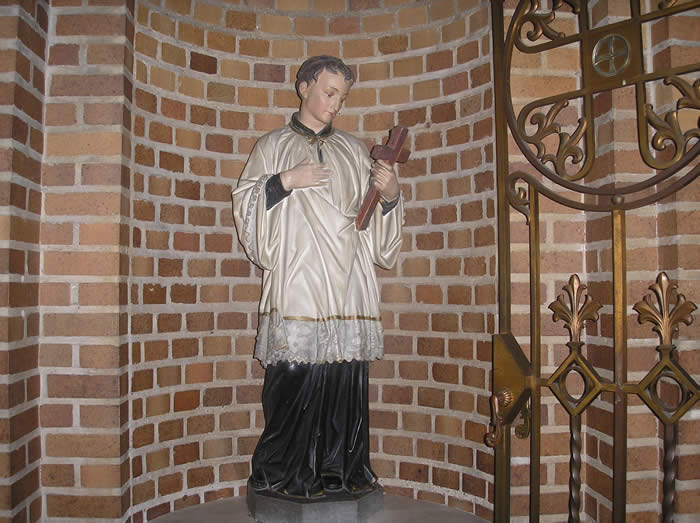
Statue of Saint Aloysius Gonzaga, Vestibule of Saint Aloysius Church, Great Neck, New York, Saturday, November 24, 2007.
On the Fourth Sunday after Pentecost